Reviewed by the Freelance OS editorial team · Editorial policy
UpworkUpwork Profile Readiness Checklist: What to Fix Before You Send Another Proposal
A weak Upwork profile makes strong proposals harder to trust. Fix positioning, proof, niche clarity, service fit, and trust signals before sending more bids.
- upwork-profile
- readiness
- optimization
- proposals
A weak Upwork profile turns good proposals into low-trust applications. Before you send another batch of bids, fix the parts clients check after your opening line: positioning, proof, niche clarity, service fit, rates, availability, and visible trust signals. Freelance OS, an AI operating system for freelancers, can help score those gaps in the Profile Readiness Hub, but the core work is simple: make your profile prove the same promise your proposals make.
#TL;DR
- Your profile should make your proposal easier to believe, not force the client to guess what you do.
- Fix your title, first overview lines, portfolio proof, niche offer, and trust signals before bidding heavily.
- A clear niche means clients can quickly understand the problem you solve, not that you can only serve one industry.
- Your rate, availability, completeness, and work history also affect trust, especially when clients compare similar freelancers.
- Use Profile Optimizer for profile rewrites and Career Coach if you need a weekly improvement plan.
#What does an Upwork profile need before you apply?
An Upwork profile needs a clear service promise, credible proof, and a logical match between your skills, portfolio, rate, availability, and proposal claims. Clients often skim your proposal first, then click your profile if the offer sounds relevant. If the profile feels vague, mismatched, or unfinished, the proposal loses force.
Before applying heavily, check whether a client can answer these questions in under 30 seconds:
- What specific service do you provide?
- Who do you help?
- What outcome or problem do you work on?
- What proof shows you can handle similar work?
- Does your rate make sense for the promise you are making?
- Are you available enough for the type of project you are targeting?
A beginner profile does not need ten polished case studies. It does need enough clarity that a client understands what they would hire you for. “WordPress Developer” is broad; “WordPress speed optimization for service business websites” is easier to evaluate.
Your Freelancer Profile should also be complete enough to support your applications: current skills, relevant portfolio items, a realistic rate, work history where available, and profile details that match the jobs you want.
#How do you know if your niche is clear?
Your niche is clear when a qualified client can recognize themselves in your title, first two overview lines, portfolio examples, and proposal angle. It does not have to be permanent. Early on, treat your niche as a working hypothesis that helps you choose better jobs and write sharper applications.
A practical test: remove your name and profile photo, then ask whether the profile still points to a specific buying situation. If it could describe thousands of freelancers with the same skill label, it is probably too generic.
Clear niche signals often include:
- A role plus outcome: “Email copywriter for abandoned cart recovery”
- A buyer type: “Landing pages for SaaS founders”
- A project type: “Shopify product page redesigns”
- A constraint: “Fast Webflow fixes for funded startups”
- A measurable pain: “Reducing slow WordPress load times”
A common exception is the early generalist who is still collecting data. In that case, choose two or three adjacent service lanes rather than presenting yourself as available for anything. “Brand identity, pitch decks, and landing page visuals for early-stage startups” is broader than one service, but it still gives clients a pattern.
#What profile gaps make clients hesitate?
Clients hesitate when your profile creates extra uncertainty. The most common gaps are not dramatic mistakes; they are small inconsistencies that make the client wonder whether you understand the project, whether you have done similar work, or whether your proposal was written without much judgment.
| Profile area | What clients look for | Readiness check | Fix before bidding |
|---|---|---|---|
| Profile title | A specific service and buyer-relevant outcome | Does it say more than a job label? | Replace vague titles with service-plus-result positioning |
| Overview | A fast explanation of who you help and how | Do the first two lines match the jobs you want? | Lead with client pain, service fit, and proof |
| Skills | Skills that support the service offer | Are skills scattered across unrelated categories? | Keep the strongest skills tied to your niche |
| Portfolio proof | Evidence of similar work or thinking | Can a client see relevant examples quickly? | Add case studies, before/after notes, or sample audits |
| Niche offer | A clear reason to hire you for this work | Is your offer easy to repeat in proposals? | Define one or two service packages or project types |
| Client trust signals | Signs you are reliable and professional | Are process, outcomes, testimonials, or work history visible? | Add scope details, results, communication norms, and next steps |
| Rate alignment | A price that fits the service promise | Does your rate match your proof level and market? | Adjust rate, proof, or offer so they support each other |
| Availability | Confidence that you can actually start | Is your availability current and believable? | Update hours, response expectations, and project capacity |
| Profile completeness | Enough detail to reduce doubt | Are key sections empty or outdated? | Fill missing sections before sending a large proposal batch |
| Work history | Evidence of reliability where available | Does past work support the service you now sell? | Feature relevant history and explain pivots clearly |
Tip
#What does a quick profile audit look like?
A useful audit compares what your profile says now with what a skeptical client needs to believe before replying. Focus first on the title, first overview lines, and portfolio proof because those are the fastest trust signals to improve.
Here is a realistic mini audit for a freelancer targeting Shopify conversion work:
| Section | Weak version | Improved version | |||
|---|---|---|---|---|---|
| Title | Shopify Expert \ | VA \ | Data Entry \ | Canva | Shopify Product Page & Conversion Fixes for Ecommerce Stores |
| First overview lines | “I am a hardworking freelancer with experience in Shopify, Canva, admin support, and customer service. I can help with many tasks and deliver quality work.” | “I help Shopify store owners improve product pages that get traffic but do not convert. I focus on page structure, offer clarity, product descriptions, trust blocks, and simple UX fixes.” | |||
| Portfolio proof | One screenshot of a homepage with no explanation | A short case study showing the original product page issue, the revised layout, copy changes, trust elements added, and the reasoning behind each decision |
The improved version does not make exaggerated claims. It simply gives the client a clearer hiring reason. A client with a Shopify product page problem can now connect the proposal, profile, and portfolio in one quick scan.
For beginners, the portfolio proof can be a sample audit or mock improvement. Label it honestly. A strong teardown of a real buying problem is often more persuasive than a pretty screenshot with no context.
#How should your profile connect to proposals?
Your profile and proposals should tell the same story from different angles. The proposal speaks to one job; the profile proves that your broader experience supports the claim. When those two assets contradict each other, clients often choose the safer freelancer.
For example, if your proposal says, “I specialize in Shopify conversion fixes,” but your profile title says “Virtual Assistant | Data Entry | Canva | Shopify,” the client may assume Shopify is a side skill. If your portfolio has no ecommerce examples, the trust gap gets wider.
Use this workflow before sending a proposal:
- Read the job post and identify the main business problem.
- Check whether your title and first overview lines support that problem.
- Choose one relevant portfolio proof point, work sample, or audit.
- Write the proposal around the client’s situation, not your full biography.
- Make sure the profile visit confirms the same specialty.
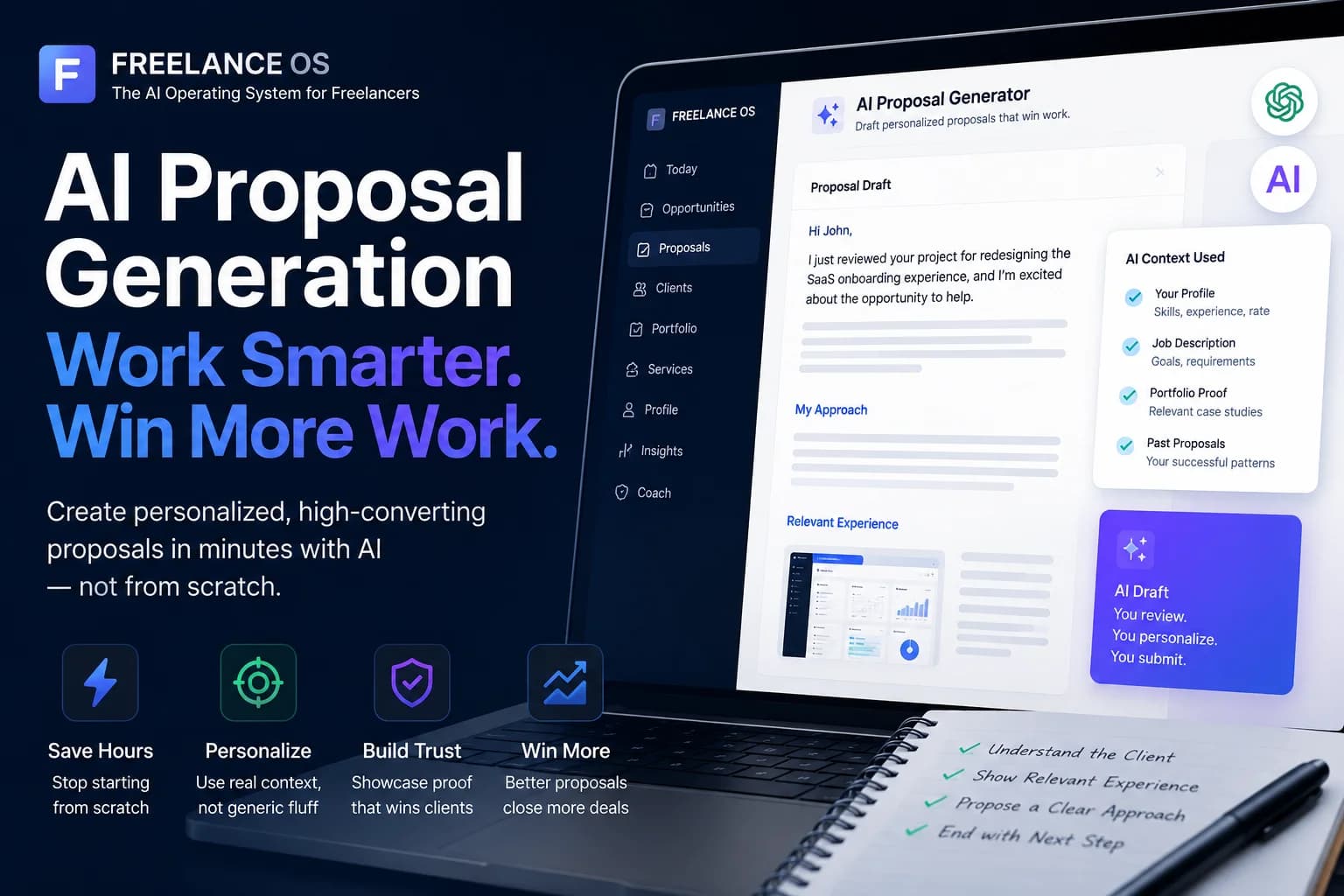
The Write a Proposal tool can help draft proposals with variants, discovery questions, and trust checks. Still, the profile has to carry its share of the work. A polished proposal cannot fully compensate for a profile that points in five different directions.
#How can Freelance OS help with profile readiness?
Freelance OS helps turn profile improvement into a scored workflow instead of a vague “make it better” task. The Profile Readiness Hub reviews readiness gaps, niche clarity, and improvement priorities so you can fix the highest-impact sections first.
A practical sequence:
- Start with profile readiness to identify weak sections.
- Rewrite the title, overview, skills, and portfolio positioning in Profile Optimizer.
- Update your profile data so future proposals draw from accurate positioning.
- Draft applications only for jobs that match the profile promise.
- Use Career Coach if you need a weekly plan across profile, proposals, follow-ups, and client pipeline habits.
The expert move is to fix one bottleneck at a time. If your niche is unclear, rewriting ten proposals will not solve the positioning problem. If your profile is strong but replies are weak, job selection, opening lines, or follow-up strategy may need more attention.
#Frequently asked questions
#Should I stop sending proposals until my profile is perfect?
No. A perfect profile is not required, and waiting too long can become avoidance. But if your profile is vague, proof-light, or inconsistent with your target jobs, slow down and fix the highest-impact sections before spending heavily.
A useful middle ground is to send a small number of carefully chosen proposals while improving your title, overview, and portfolio proof. Watch whether profile views turn into replies.
#What should beginners put in a portfolio without client work?
Beginners can use practice projects, sample audits, mock redesigns, teardown documents, or before-and-after examples. The key is to explain the problem, your process, and the decision-making behind the work.
Do not present sample work as paid client work. Clients mainly need evidence that you can think through the type of project they have.
#How do I know if my Upwork rate is hurting my profile?
Your rate may be hurting trust if it does not match your proof level, service complexity, or target client. A high rate with no relevant proof can feel risky; a very low rate for a specialized service can also make clients wonder what is missing.
Align the rate with the offer. If you want to charge more, strengthen the portfolio proof, narrow the service promise, and make your process clearer.
#How often should I update my Upwork profile?
Update your profile whenever your target service changes, you complete a stronger project, or your proposals start attracting the wrong leads. For active freelancers, a monthly review is usually enough.
If you are stalled, review it weekly for a short period. Focus on one section at a time: title one week, overview the next, proof after that.
#Is a narrow niche risky on Upwork?
A narrow niche can feel risky because it seems to reduce the number of jobs you can apply for. In practice, it often improves how quickly good-fit clients understand your value.
The risk comes from choosing a niche with too little demand or one you cannot prove. Choose a niche where you have some skill, visible examples, and enough recurring job posts to support consistent applications.
#Key takeaways
- A weak Upwork profile can make strong proposals feel less trustworthy.
- Profile readiness starts with clear positioning, relevant proof, niche clarity, service fit, and basic trust filters.
- Your rate, availability, completeness, and work history matter because clients compare risk, not just skill.
- Your proposal should point to a claim your profile can verify.
- Freelance OS can help score readiness gaps, rewrite profile sections, and turn profile improvement into a weekly workflow.