Reviewed by the Freelance OS editorial team · Editorial policy
FreelancingUpwork vs Fiverr: Which Freelance Platform Is Better in 2026?
Upwork favors freelancers who prefer applying to tailored projects and building long-term client relationships. Fiverr suits productized services that buyers can discover and purchase with less upfront negotiation.
Upwork and Fiverr serve different freelance business models. Upwork is usually better for freelancers who want to pursue specific jobs, negotiate scope, and develop ongoing client relationships. Fiverr is often better for sellers who can package a repeatable service with clear pricing, deliverables, and turnaround times. The right choice depends on your service, experience, acquisition style, and business goals.
#Upwork vs Fiverr at a glance
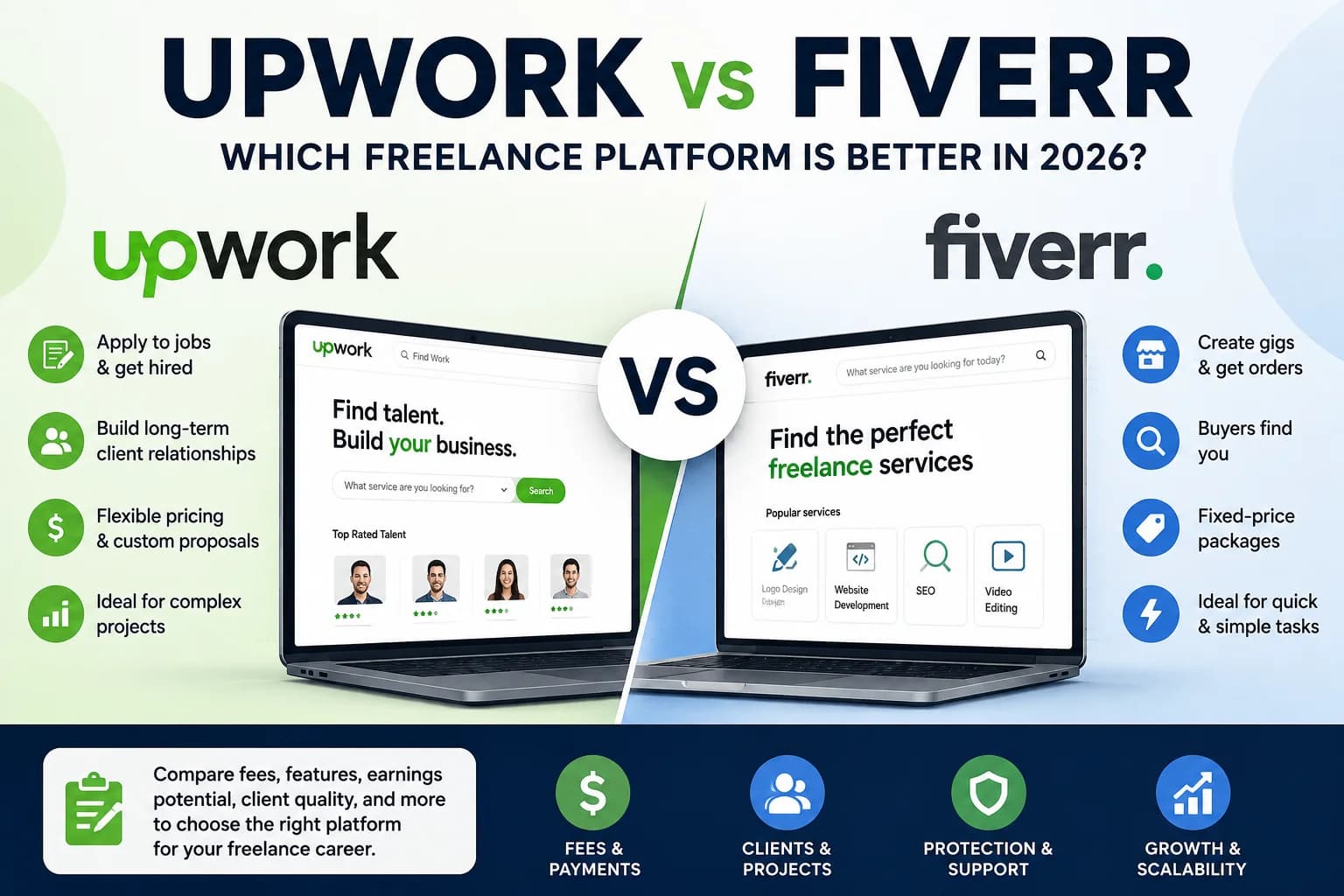
The central difference in the Upwork vs Fiverr comparison is how work begins. On Upwork, freelancers usually find a job post and submit a proposal. On Fiverr, sellers publish predefined services called Gigs, and buyers discover them through search, recommendations, or direct inquiries.
| Factor | Upwork | Fiverr |
|---|---|---|
| Primary model | Freelancers apply to posted jobs | Buyers purchase or inquire about Gigs |
| Best suited to | Customized, complex, or ongoing work | Repeatable, clearly packaged services |
| Freelancer fee | Generally 10% of earnings | Generally 20% of order value |
| Upfront acquisition cost | Connects may be required to apply | Publishing a Gig does not require proposal credits |
| Pricing | Hourly, fixed-price, milestones | Packages, extras, subscriptions where available, and custom offers |
| Client relationship | Often project-based or long term | Often transactional, but repeat work is possible |
| Discovery | Search for jobs, invitations, promoted visibility | Search ranking, recommendations, briefs, and inquiries |
| Reputation | Job Success Score, reviews, earnings, badges | Seller level, ratings, reviews, response and delivery performance |
| Payment structure | Hourly protection or funded milestones | Buyer funds the order through Fiverr |
| Typical strength | Selecting and pitching relevant opportunities | Turning a standardized service into an inbound storefront |
Fees, eligibility rules, withdrawal options, and marketplace features can vary by account and location. Check the official support pages before making pricing or cash-flow decisions.
#How Upwork works for freelancers
Upwork operates primarily as an application marketplace. Clients publish jobs with a description, budget, required skills, and experience level. Freelancers search those listings, evaluate the client and scope, spend Connects where required, and submit proposals containing a rate, relevant proof, and an approach to the project.
A typical process looks like this:
- Create a specialized profile with a title, overview, skills, work history, and portfolio.
- Search for jobs or receive invitations from clients.
- Review the budget, client history, scope, and required Connects.
- Submit a tailored proposal, sometimes with screening answers.
- Interview, agree on terms, and accept an hourly or fixed-price contract.
- Record hourly work correctly or submit funded milestone work.
- Receive payment after the applicable review and security period.
Connects create a direct cost for job applications. Upwork has historically priced Connects at $0.15 each, while the number needed for a job varies. Availability through plans, promotions, or account benefits can change, so verify the current amount through Upwork Support.
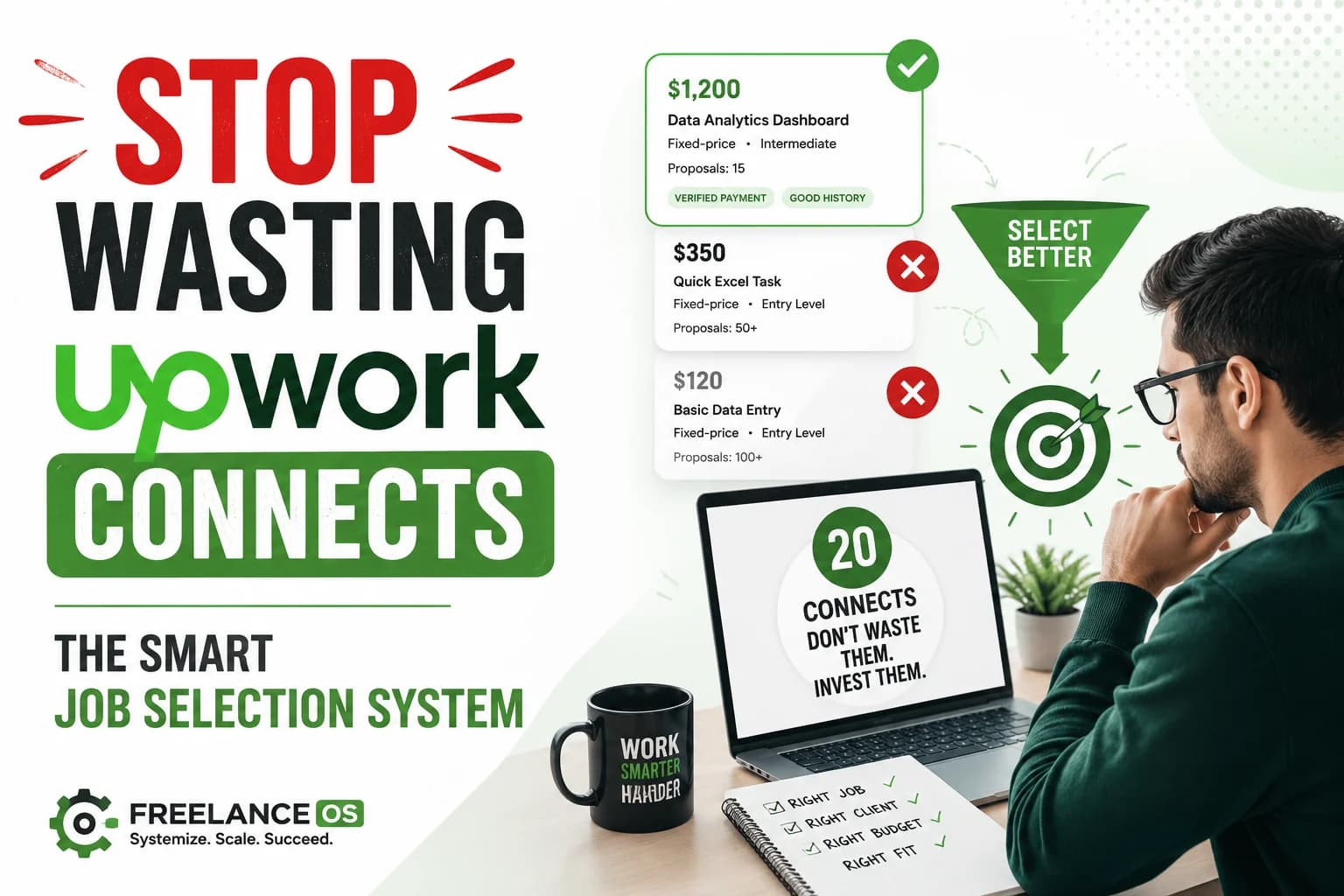
Strong job selection matters more than application volume. A $1,500 project requiring 16 Connects may justify a carefully written proposal; a vague $30 listing with the same competition may not. Freelancers can use a job analyzer to assess fit and risk before spending Connects, then track actual acquisition cost through Connects and ROI analytics.
#How Fiverr works for freelancers
Fiverr operates primarily as a service marketplace. Freelancers create Gigs describing a defined outcome, such as “I will design a three-page Webflow website” or “I will edit a 1,500-word B2B article.” Buyers can purchase a package directly or contact the seller for a custom offer.
Each Gig normally includes:
- A title, category, tags, and service description
- Portfolio images, video, or work samples
- Basic, Standard, and Premium packages where appropriate
- Delivery times, revision limits, and optional extras
- Buyer requirements needed before work starts
- Frequently asked questions and scope boundaries
Fiverr search visibility depends on relevance and marketplace performance signals. Reviews matter, but so do responsiveness, completed orders, cancellations, on-time delivery, and buyer satisfaction signals that may not all be public.
Fiverr has replaced the old open Buyer Requests workflow in many contexts with matching features such as briefs and personalized opportunities. Sellers should not build their entire strategy around receiving those matches. Clear Gig positioning, strong examples, and prompt handling of qualified inquiries remain the more controllable inputs.
#Getting started and winning the first project
Upwork is faster for actively pursuing visible demand, while Fiverr is easier to publish on but can take longer to generate organic discovery. A new Upwork freelancer can apply as soon as the profile is ready and suitable jobs appear. A new Fiverr seller can create a polished Gig without spending application credits, but the Gig may initially have little search visibility or reputation.
On Upwork, the first-job challenge is earning trust without platform reviews. Counter that with external proof: show a case study, explain your exact contribution, and propose a small first milestone. Before applying heavily, use a profile readiness checklist to check niche clarity, proof, service fit, and trust signals.
On Fiverr, narrow Gigs generally communicate better than broad ones. “I will write cybersecurity case studies for B2B SaaS companies” gives the buyer more confidence than “I will write any content.” Use a service page generator to adapt one well-defined offer for Fiverr, Upwork, LinkedIn, and your own website.
Tip
#Fees, payments, and withdrawals
Upwork generally charges freelancers a 10% service fee on earnings. Fiverr generally keeps 20% of the order value, leaving the seller with 80%. On a $1,000 client payment, that is approximately $900 before taxes on Upwork and $800 before taxes on Fiverr, excluding Connects, optional promotion, currency conversion, or withdrawal charges.
Upwork supports hourly and fixed-price contracts. Hourly protection depends on qualifying time recorded through Upwork’s required process. Fixed-price protection generally depends on funded milestones, documented submissions, and using the contract workflow. Earnings become withdrawable after the applicable review and security periods.
Fiverr collects the buyer’s payment through the order system. After delivery and order completion, seller funds normally pass through a clearance period before withdrawal. PayPal, Payoneer, and bank-transfer availability can depend on country and account status.
Policies and timelines change. Consult Fiverr Help and Upwork Support for current clearance periods, withdrawal minimums, payment methods, and fees.
#Clients, project types, and earning potential
Upwork tends to fit work that requires diagnosis, collaboration, or changing scope. Examples include a six-month software build, ongoing executive assistance, a content marketing retainer, or conversion tracking across several advertising channels. Hourly contracts and milestones make larger engagements easier to structure.
Fiverr tends to fit services that can be specified before purchase: logo concepts, podcast editing, landing-page copy, WordPress bug fixes, voice-over recordings, or a defined SEO audit. Custom offers allow larger projects, but sellers still need firm boundaries around inputs, revisions, and delivery.
| Profession | Usually stronger starting point | Reason |
|---|---|---|
| Developers | Upwork | Complex builds often require discovery and ongoing collaboration |
| Designers | Either | Upwork suits broader projects; Fiverr suits defined assets and packages |
| Writers | Either | Upwork fits retainers; Fiverr fits repeatable article or editing packages |
| Marketers | Upwork | Campaign management and analytics are often ongoing |
| Virtual assistants | Upwork | Hourly and recurring support align well with the service |
| Video editors | Fiverr or either | Standard editing packages sell well, while ongoing channels suit Upwork |
| Voice-over artists | Fiverr | Buyers can evaluate samples and order by a defined word count |
| Consultants | Upwork | Scoping, interviews, and longer contracts are common |
Neither marketplace sets a simple earnings ceiling. In practice, earning potential depends on specialization, proof, sales skill, repeat business, capacity, and pricing discipline. Fiverr’s 20% fee needs to be built into every package; Upwork users should include Connects and proposal time in acquisition costs.
#Reviews, protection, and disputes
Both marketplaces use reviews and operational performance to reduce buyer risk. Upwork emphasizes contract outcomes, client feedback, work history, and Job Success Score. Fiverr combines public reviews and seller levels with operational measures such as responsiveness, delivery performance, and cancellations.
Protection is conditional on using the marketplace correctly. Keep scope, approvals, files, and key decisions in the platform’s messages and contract tools. On Upwork, confirm that a milestone is funded before starting fixed-price work. On Fiverr, make buyer requirements, included revisions, and delivery contents explicit.
Dispute processes can help enforce documented agreements, but they cannot repair a vague scope. A written acceptance criterion such as “delivery includes three responsive page templates in Figma and two revision rounds” is more defensible than “design a modern website.”
#Advantages and disadvantages
| Platform | Advantages | Disadvantages |
|---|---|---|
| Upwork | Active job search; hourly and milestone structures; flexible negotiation; stronger fit for ongoing work | Connect costs; proposal effort; crowded listings; variable job quality |
| Fiverr | No Connect-style cost to publish; inbound ordering; strong fit for productized services; package upsells | 20% seller fee; search dependence; strict delivery pressure; scope creep through poorly designed Gigs |
#Which is better: Upwork or Fiverr?
Upwork for beginners makes sense when the freelancer can identify good jobs, write credible proposals, and demonstrate relevant work even without marketplace reviews. Fiverr for beginners makes sense when the freelancer has a narrow, visual, or easily packaged service and prefers buyer discovery over repeated applications.
Experienced freelancers often have an advantage on Upwork because they can use specialized proof to pursue larger contracts. Fiverr can be equally useful for experienced specialists who turn a repeatable process into profitable packages and delegate or streamline delivery carefully.
Using both can work, but only if the offer fits both channels. Do not duplicate a generic profile and expect equal results. Use Upwork for consultative or ongoing engagements and Fiverr for fixed-scope entry services, then compare net hourly earnings, conversion rate, repeat business, and acquisition cost after 60 to 90 days.
#Practical success tips
For Upwork:
- Apply selectively based on fit, client history, scope quality, and likely return.
- Open with the client’s problem rather than a biography.
- Include one highly relevant proof point and a sensible next step.
- Track proposals, replies, interviews, and wins in a proposal pipeline.
- Stop bidding in categories where Connect spending repeatedly produces weak returns.
For Fiverr:
- Build one Gig around one buyer intent.
- Show the output buyers will receive, not merely a list of skills.
- Set revision limits and define what counts as a revision.
- Respond quickly without accepting unclear work.
- Test thumbnails, titles, packages, and FAQs one variable at a time.
#Reducing dependence on freelance marketplaces
Upwork and Fiverr can supply demand, payment infrastructure, and early credibility, but they should not be the only assets in a freelance business. Search visibility, account eligibility, fees, and marketplace rules remain outside the freelancer’s control.
Use completed work to build portable business assets:
- Turn successful projects into permission-based case studies.
- Develop a clear service with repeatable scope and pricing.
- Maintain professional client relationships within each marketplace’s terms.
- Build a personal website, referral network, and owned audience.
- Track client concentration so one marketplace or client does not dominate revenue.
- Create a simple CRM for leads, past clients, follow-ups, and referrals.
Freelance OS, an AI operating system for freelancers, includes a Portfolio Studio for turning project notes into case studies and shareable showcases. The goal is not to abandon marketplaces prematurely. It is to build enough proof, process, and direct demand that a policy change does not stop the business.
#Frequently asked questions
#Is Upwork better than Fiverr for beginners?
Upwork is often better for beginners prepared to apply actively and tailor each proposal. Fiverr can be better for beginners with a specific, package-friendly service, although receiving the first organic order may take time.
#Which platform charges freelancers less?
Upwork generally charges a 10% freelancer service fee, while Fiverr generally keeps 20% of the order value. Upwork applicants may also spend money on Connects, so compare total acquisition cost rather than the headline fee alone.
#Can freelancers use Upwork and Fiverr together?
Yes. This works best when each channel has a defined role, such as Upwork for ongoing contracts and Fiverr for fixed-scope services. Account for deadlines across both systems and follow each marketplace’s communication and payment rules.
#Which platform is better for long-term clients?
Upwork is generally structured more naturally for long-term hourly contracts, retainers, and milestone projects. Fiverr can produce repeat clients, but its Gig model begins with a more transactional purchase.
#What is the final verdict on Fiverr vs Upwork?
There is no universally best freelance platform. Choose Upwork if you prefer selecting jobs, writing proposals, negotiating scope, and building longer engagements. Choose Fiverr if you prefer packaging services, attracting inbound buyers, and delivering standardized outcomes. Test both only when you can measure results without diluting your positioning.